
Common Skin Problems and Treatment: Hives, Burns & Sunburn
- Sep 25, 2024
- 8 min read
Updated: Aug 1, 2025
Hives-Burns-Sunburn
The following addresses some common skin problems and treatment: hives, burns & sunburn -
HIVES (URTICARIA)
Hives are itchy, raised, irregular areas of the skin. They usually appear because of an allergy or sensitivity to something, or can sometimes be due to a chronic underlying illness like hypothyroidism, hepatitis, or even cancer. They can be scattered or multiple, and sometimes diffuse. I find that this is one of the most Interesting rashes to work up because of all the investigational work surrounding the diagnosis. So many things can cause them.

If you are trying to figure out the cause of a case of hives, there are a
number of things you need to ask yourself (and remember, you can develop an
allergy to something even if you have NEVER had a problem with it). Ask yourself these questions, and you may be able to discover the culprit yourself:
Am I taking any new medicines (or have I completed any prescriptions in the last two weeks)? Drug reactions can occur up to several days after you have taken the medicine. While this is especially true of antibiotics, it can be caused by other, more common medications like aspirin or ibuprofen.
Have I eaten any of the following recently: Strawberries, shellfish, nuts, dairy, food additives, or preservatives?
Was I been exercising right before this came on (exercise-induced hives)?
Have I been unusually stressed?
Have I been in extreme cold or heat? Sometimes, being in an extreme temperature can cause hives (hives from heat are rare)
Did this come on right after being in the sun (solar urticaria) (fairly common)
Was I sick with an infection or getting sick?
Have I changed to any new soaps, detergents, lotions or sunscreens?
Have I had contact with an insect?
Could it be from the pollen or from rubbing up against plants?
Have I had contact with an animal?
There are some other, more unusual causes of a hive-like rash. For example, several hours after pressure is applied to the skin, hives sometimes appear in that area. Sudden rubbing or stroking of the skin may cause local hives in the outline of the stroked area (dermatographism), skin vibration, and water exposure can also cause hives.
First, in the case of any rash of unknown cause, it is recommended that you make a diary or list of each thing you were in contact with when the rash came on: Foods you have eaten over the last 1-2 days, medications taken over the previous two weeks, soaps, creams, lotions (including sunscreens) you have applied to your skin and any circumstances- in the cold, heat or sun for an extended period? If the hives come on again, you may be able to compare
notes to identify a common factor each time they appeared.
It is important to note that even though you may not have had an allergy to something in the past, you can develop an allergy to it later in life.
General Approaches to Hives
First, clean the area with mild soap and lukewarm water. Pat dry.
Apply cool, moist compresses and oatmeal baths, and you might try a baking soda paste in water, 3:1
Do not scratch
Avoid heat and hot water - these may feel good, but worsen the rash!
Of course, avoid the source if you know what it is
Over-the-Counter Medicines for Hives
If the hives are not life-threatening, are spreading gradually over several hours, and remain relatively localized, you have several treatment options—especially oral antihistamines (see below). No matter what approach you take, keep a close eye on the hives to make sure they are not progressing. If they continue to get worse, go to urgent care.
Topical Agents - applied to the skin - can be used for milder, localized cases (applied to your skin)
Steroid creams (not recommended to use extensively on the face), like hydrocortisone (common: Cortisone 10, Cortaid)
Calamine/Caladryl lotions
Oral Antihistamines may make you drowsy, but are usually quite effective in non-severe cases.
Benadryl/diphenhydramine (drowsy, effective, less expensive)
Zyrtec/fexofenadine (drowsy, effective, more costly)
Claritin/loratadine (non-drowsy, less expensive)
Xyzal/levocetirizine (expensive)
Naturopathic (over-the-counter): Hyland's Hives (Naturopathic)
These are often the first over-the-counter go-to remedies for hives. Start early at onset and heed label warnings. When in doubt about what to use, ask a pharmacist.
Natural/Herbal Approaches (These may be used in conjunction with measures above).
Oatmeal, baking soda, or witch hazel bath additives
Wear loose-fitting clothes
If you are looking for herbal remedies, consider:
Prescriptive Treatments for Hives
Corticosteroids—(common: prednisone, dexamethasone). These are the mainstay of treatment for hives and allergic reactions, and they can be taken orally or injectable.
Diphenhydramine - Injectable antihistamine.
Epinephrine - Injectable. For a severe reaction.
Most of the time, a person can relieve hives with antihistamines, but if they are not responding to the over-the-counter treatments (above); if they are rapidly spreading, if they are accompanied by other symptoms like lip or tongue swelling, wheezing, difficulty breathing, and much facial involvement, they should go to urgent care or the ER right away. The reaction can progress into a full-blown, life-threatening anaphylactic reaction.
If the hives recur over and over again, you should consult a healthcare provider. Many people get one or two brief episodes and never discover the cause.
BURNS

Our moms used to put butter on our burns. Since then, they have figured out that this is not a very good idea. It actually keeps the heat in the skin, which can cause more damage.
First-degree burns are typically slightly swollen, red, and tender (some describe it as "looking like a localized sunburn").
Second-degree burns are similar but worse with blistering. If your burn is large (>2-3 inches), on a joint or the face, or has dead tissue stuck to the wound ("clumped up"), you should see a healthcare provider.
Third-degree burns are serious and require immediate attention - go to an ER or Urgent Care ASAP. This is especially true of areas on the face/ears, joints, or groin. These burns are also called "full-thickness" - they have little to no sensation (because the underlying nerves are damaged) and they often turn white. These can extend to the underlying soft tissues and bone (Beware of pressure cookers! Follow directions - these can (and do)cause severe burns if not used correctly!)
General Approaches to a Burn
When you get burned, run cold water on the area under RIGHT AWAY for several minutes or apply a cool, wet cloth (no ice).
Wash it gently with soap and water (do this twice daily until healed). If it is closed and fairly small, leave it open to air as long as it is not exposed to an irritant, like clothing; otherwise, cover it with a nonstick bandage/Band-Aid.
Elevate the area if possible.
Watch for signs of infection, such as increasing redness, warmth, swelling, tenderness, pus, fever, or red streaks coming from the wound.
Keep covered -
Do not pop blisters - these are "natural Band-Aids" and keep the underlying area sterile.
Over-the-Counter Medicines
Gels and ointments -
There are a couple of different approaches to this:
You can use a thin layer of ointment like Vaseline and a non-stick bandage if there is no infection. According to most dermatologists these days, Vaseline is less likely to cause a local allergic reaction/inflammation than antibiotic ointments, but it does not have antibiotic properties.
If you are concerned about infection, you can use an antibiotic ointment (common: Neosporin or Bacitracin) and cover with a NONSTICK bandage.
However, . This is really a matter of risks (irritation) vs. benefits (control of infection). If you are concerned about infection, please see the page on "Skin: Bacterial Infections."
Oral Medications
Anti-inflammatories (NSAIDS) - (common: Ibuprofen/Motril, Advil, Naproxen/Aleve, Acetylsalicylic acid/Aspirin). Over the counter as directed for pain.
Pain medicine: (common: Acetaminophen/Tylenol), as directed.
Natural/Herbal Remedies
Prescriptive Treatments for Burns
Antibiotic cream: Silver sulfadiazine (common: Silvadene). Used frequently to prevent and treat infections caused by second and third-degree burns. While it is not a painkiller, some patients tell me that it helped soothe the burn. Avoid with Sulfa allergies.
High dose Ibuprofen (anti-inflammatory) - prescription only
Pain Medications: For more severe burns - (common: Oxycodone, hydrocodone, Ultram/Tramadol). And other opioids for other very severe burns.
It is very important to see a medical provider if it is a bad burn, especially if it is extensive, is on a joint, or on your face, or accompanied by a fever.
SUNBURN
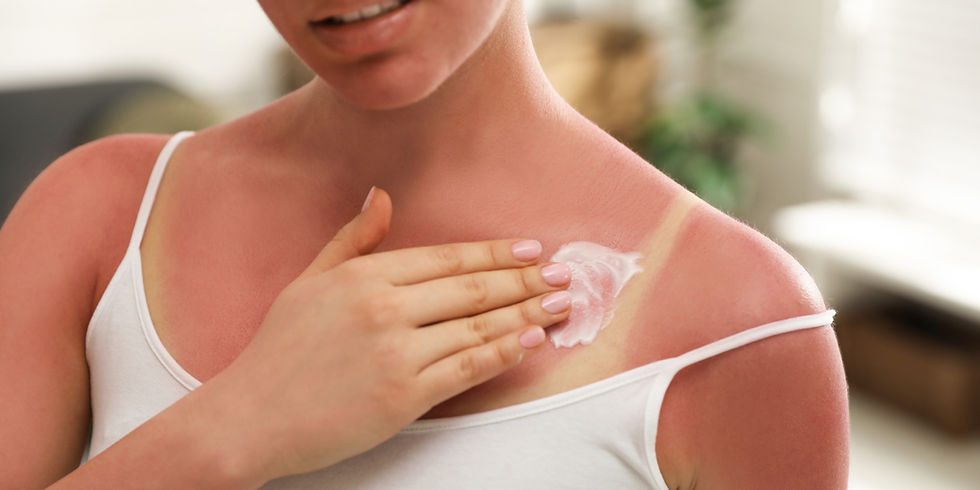
This is, unfortunately, quite common. It can be first-degree (red and tender) and second-degree (red, very tender, and blistering). The American Academy of Dermatology recommends the following approaches to a sunburn:
General Care of a Sunburn
Take cool showers or baths
Keep areas clean with mild soap and water - Pat dry
Do not pop blisters - These protect the underlying area
Over-the-Counter Approaches
Use a moisturizer (especially one containing Aloe)
Hydrocortisone Cream
Benzocaine - (common: Dermoplast - contains benzocaine-an anesthetic, aloe vera, menthol, vitamin E, lanolin)
If you can take one or the other, take Aspirin or an NSAID nonsteroidal anti-inflammatory over-the-counter as directed - these are good anti-inflammatories (I have actually seen better results with Aspirin).
Skin Damage and Cancer: In general, AVOID a lot of sun. Squamous cell cancer and Melanoma are forms of skin cancer that are common in people who have spent much time in the sun. Anyone - from farmers to "tanners" (indoor AND outdoor) can and do get this, and the incidence is increasing. Basically, the UV rays from the sun hit your skin, altering a cell's DNA. The DNA typically sends instructions to other cells about how to grow. When the DNA gets messed up, the instructions get messed up, and the skin can start to grow in a crazy, cancer-type pattern. This type of cancer can spread to other parts of your body and can be life-threatening.
Consider seeing your dermatologist every year to have a skin check. They have special equipment to inspect your moles. It would be best if you had a suspicious mole checked. Some of the signs are a change in a mole, bleeding from a mole, irregular shape or irregular colors (usually moles are just one color), a change in the shape, color, and size of a mole (larger than 1/4 of an inch), if it "feels" odd to touch, is developing redness or is itchy. It is hard for a non-specialist to guess these things. If the provider says it is fine, but it continues to change, have it checked again.
Note About Sunscreens - You just can't win sometimes. Recently, it was discovered that the skin absorbs certain sunscreens, which can cause problems in your body. The chemicals include oxybenzone, octinoxate, parabens, and homosalate, which can cause temporary endocrine (hormone) disorders, organ toxicity (oxybenzone), and allergic rashes. They can also be harmful to the environment. Stay away from this stuff.
I have also seen several people with sunscreen sensitivity break out in a rash after using various sunscreens. They contain preservatives, fragrances, dyes, and several other components that may cause a rash. If you suspect an allergy (rash) after using sunscreen, take note of the brand and change to a different sunscreen. If it happens again, compare ingredients to see what they have in common. You can also apply it to a small area of your body to see if you have a reaction in that area. Avoid those ingredients in the future. Zinc oxide sunscreens are a good alternative.
There are many sunscreens out there. Read the labels and find an alternative. In general, you should use SPF 30 or higher and water-resistant. The higher, the better. You don't need a tan to make yourself attractive! And that scar won't be attractive if you get skin cancer.
If you are going to be in the water, some sunscreens are not waterproof! They wash off easily and won't protect you. In general, it is important to reapply them every two hours whether you are inor out of the water. Additionally,somecontain potentially harmful additives including oxybenzone, parabens, and synthetic fragrances - especially if you have sensitive skin.
Lean toward using mineral sunscreens (with zinc oxide or titanium dioxide). They tend to be gentler and less likely to irritate the skin.
If you feel that your condition is too complicated or severe to be treated by the abovementioned recommendations in Common Skin Problems and Treatment: Hives, Burns & Sunburn, please see a healthcare provider.


