
Read More About What "Tea" Is: Potential Benefits, How to Choose a Good Tea, Making Your Own Tea and Tea Blends
- Jan 20
- 6 min read
Updated: Mar 10
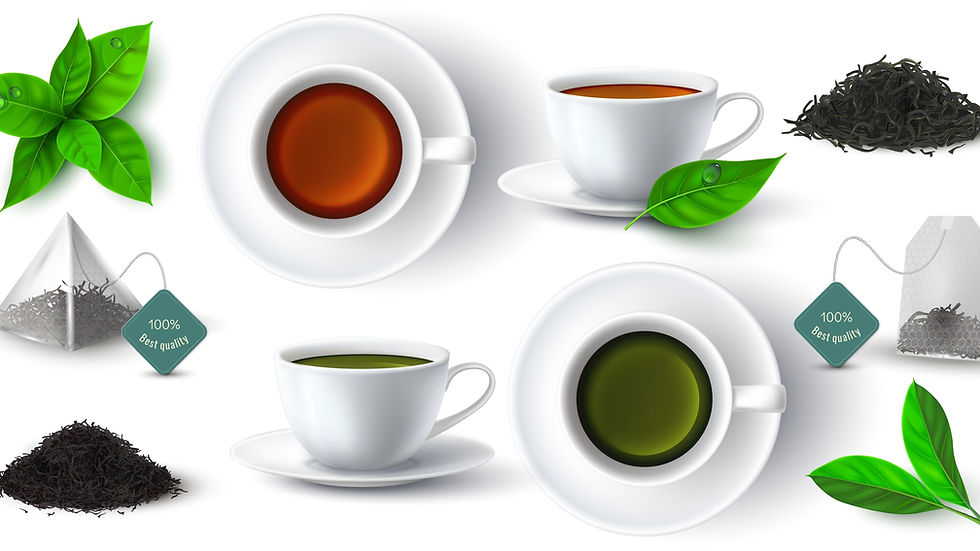
WHAT IS TEA? (It really is not what you think it is: You may be surprised at the answer!)
Tea may not be what you think it is. There are two main types of teas: basic teas and blended herbal teas. Here’s something that may surprise you: many herbal “teas” are not “teas” at all because they do not contain the tea plant Camellia sinensis).* Instead, herbal "teas" are actually called “tisanes.” Both teas and tisanes are known as "infusions," and they carry unique yet equally supportive properties for health and wellness.
Tea and Tisane Varieties
1. True Teas
“Real teas” are made from the basic tea plant Camellia sinensis. These include:
Black teas (Darjeeling, Assam, Turkish, and Ceylon)
Green tea
Oolong teas
White tea
Pu-erh tea
2. Blended Herbal Teas
These teas include one of the true teas mentioned above, combined with an herb substance (plant, extract, oil, or powder). Popular examples include:
Chai Tea: Black tea with cardamom, cinnamon, ginger, and cloves
Jasmine Green Tea: Green tea base with jasmine blossoms
Mint Tea: Black tea base with peppermint leaves
3. Herbal “Teas” (Tisanes)
As mentioned, these are not actually “teas” because they do not contain any authentic tea (Camellia sinensis). They consist solely of herbs, flowers, spices, or fruits and are otherwise considered “tisanes” or “herbal infusions.” They are typically prepared like true and blended teas. However, to simplify understanding, they are often referred to as "teas" or "infusions."
Potential Health Benefits of True and Herbal "Teas"
Many teas made from herbs and supplements are used to support health and wellness. They claim to help both the body and mind. Some people drink tea for prevention, others for recovery, and many enjoy it simply for pleasure. Whatever the reason, tea has been found to support overall well-being, offering comfort, balance, and a boost to health and daily life.
Everyday symptoms and the teas that claim to help those symptoms are discussed below. Many teas and infusions claim to soothe a sore throat, calm a cough, and even ease cold or flu symptoms. There are even teas that support heart health, digestion, urinary health, lower cholesterol, relieve muscle and joint pain, calm skin problems, and promote emotional wellness. The list is extensive.
Important Pointers About Buying and Drinking Tea
While many teas and infusions offer some support or relief for various problems, there are a few important points to keep in mind:
Some teas are well-studied, while others are not. Their health benefits may be based on human and/or animal studies, or anecdotal properties passed down through generations. While many teas show promise for health and well-being, more research is warranted. Nevertheless, drinking a specific tea for a particular symptom might help.
Most “teas” are well tolerated, but occasionally, a tea might interact with medications, cause side effects, or trigger allergies.
Tea companies in the US are not required to test their products. While understanding all aspects of a tea or infusion's quality is important, many companies do not test for everything. Some do not check for pesticides, heavy metals, microbes, microplastics, levels of active ingredients, ethical working conditions, and other aspects of tea and manufacturing. Few tea producers review all criteria (they tend to do more testing in the EU). For those interested, the testing topic is discussed in more detail below.
If you feel ill, you can try some tea; however, if you are very ill and cannot seem to get better, it is wise to consult with a healthcare provider.
Always consider safety.
Pay Attention to Manufacturer Testing of Tea
Tea: It really is not what you think it is: There may be other things in it besides tea.
Microplastics
Microplastics are a relatively recent concern. Many tea bags contain microplastics. Consuming too many microplastics has been shown to cause inflammation, immune issues, and reproductive problems, among others. While some tea companies are moving to plastic-free tea bags, plastic is still present in most conventional tea bags from brands like Bigelow, Kirkland, Lipton, Tazo, Trader Joe’s, and some Twinings.
On the other hand, many types of Numi, Pukka, Traditional Medicinals, Starwest, and Rishi teas come in plastic-free tea bags. Stash decaf Premium tea and Yogi® Green Tea Pure Green Decaf also offer plastic-free options.
Another consideration for a plastic-free tea is whole-leaf tea. Use this in a stainless-steel strainer. Numi, Rishi, Starwest, and Twinings are popular brands that carry loose-leaf forms. After extensive research on popular teas and tisanes, my favorite is Starwest. They offer bagless teas and are reputable, with third-party testing.
Organic Labeling
If I get an Organic Tea, will that assure its purity?
No. Just because it is labeled "organic" does not guarantee its purity. Yes, it will be free from synthetic pesticides, herbicides, fertilizers, or GMOs, assuring a certain amount of purity, but the term "organic" does NOT mean that it has been safely tested for heavy metals or microbes.
Heavy Metals
Most teas can contain trace amounts of heavy metals such as arsenic, cadmium, lead, and mercury, but levels vary widely depending on where and how they’re grown. Contamination can come from soil, water, or air pollution. While many teas test below regulatory limits, some can exceed safe thresholds if not carefully sourced.
Look for These Things...
If you want the highest level of purity, ensure it is "third-party tested." A third-party tester is typically an outside agency that is not the manufacturer. Third-party testing extends beyond teas to herbs and supplements. It is done to check a product for several things:
Identity & potency testing: Confirms the ingredient is present at the labeled dose.
Contaminant screening: Often looks for heavy metals (lead, arsenic, cadmium, mercury), microbes (E. coli, Salmonella), pesticides, residual solvents, and undeclared adulterants.
Manufacturing audits: Conducted to check for most, if not all, contaminants.
Some of the best-known third-party testers include Eurofins, Qalitex, Alkemist Labs, and SGS. Certification bodies like USP and NSF also play significant roles in independent third-party testing of teas and herbs. You can also contact a company to request a COA (Certificate of Analysis) for certain products.
Buying or Creating Tea Blends
If you are interested in a good herbal "tea" or infusion, you can buy the blend from a reputable tea company, create your own from recommended oils, or add your own herbs.
Making Tea Blends from OILS
Make your own blend from recommended oils. Review these safe measures:
- DO NOT ADD THESE OILS DIRECTLY TO TEAS/HOT WATER - Add to dry tea or a carrier like honey first.
- Add food-grade extracts and oils following these rules:
1. Use only food-grade essential oils. Look for oils labeled safe for internal use (e.g., USDA organic, GRAS-certified).
2. Dilute properly: Essential oils are highly concentrated. Add 1 drop to a teaspoon of honey or a sugar cube before stirring into tea—never drop oil directly into hot water.
3. Start small: Even one drop can be potent. Begin with less and adjust to taste.
4. Use a carrier: Oils don’t mix with water, so a carrier like honey helps disperse the oil and prevents it from floating on top.
Popular Oils for Tea
Citrus
- Bergamot (recommended pairing with black [Earl Grey] and white teas)
- Orange (recommended pairing: black, green, herbal, rooibos, oolong teas)
- Grapefruit (recommended pairings: green, white teas)
- Lime
Floral
- Lavender (recommended pairings: green, white, chamomile, rooibos teas)
- Rose (recommended pairings: black, white teas)
- Jasmine (recommended pairings: green and white teas)
- Neroli (recommended pairings: orange blossom)
Others
- Peppermint oil (recommended pairings: green and black teas)
- Spearmint oil (recommended pairings: green and white teas)
- Lemongrass oil
- Ginger oil (recommended pairings: black and green teas)
- Cardamom oil (recommended pairings: black teas)
- Clove oil (recommended pairing: black tea)
Oils Suggested to Avoid in Tea
Wintergreen, eucalyptus, tea tree, camphor: These can be toxic if ingested.
Clove and cinnamon: Can irritate mucous membranes if not properly diluted.
Making Tea Blends From Dry Herbs
You can also add your own herbs to your base tea (especially black or green).
Rules: Use the right ratio.
A safe starting point: 80–90% tea + 10–20% herbs.
Examples:
- Add 1-2 tablespoons of the desired herb to one cup of loose-leaf tea.
- For strong herbs (clove, cinnamon, rosemary) → use ½ tablespoon or less.
- For delicate herbs (rose, lavender) → use 1 teaspoon to start.
You can always add more, but you can’t take it out once blended.
Let the Blend Rest
Taste and adjust accordingly.
Caution: Lavender, rosemary, sage, nutmeg, clove.
Avoid: Comfrey, Coltsfoot, pennyroyal, lobelia, sassafras, too much licorice root, wormwood, ephedra, rhubarb leaves, foxglove.
As always, it is recommended that you speak to your healthcare provider before using a supplement for a particular medical condition.
I only recommend herbal and supplement brands that meet high standards for safety, transparency, and quality. I research each product before sharing it. Some links—such as Fullscript, Life Extensions, Starwest, and Nature Made—are affiliate links, which means I may earn a small commission if you purchase through them, at no extra cost to you. This helps support the free educational content on this site.


