
Manage Musculoskeletal Injuries
Updated: Jul 8, 2025
Managing Pain and Inflammation: Strains, Sprains, Carpal Tunnel Syndrome
When there is an injury, histamines and prostaglandins go to the site of the injury, where they increase vasodilation (blood vessels get bigger). More fluid, immune cells, and other substances rush to the area to promote healing and to repair the injury (see skin problems).
Strains: Some people also call these “pulled muscles”. A strain is an injury to a muscle or tendon (tissues that connect muscle to bone). It is caused when a muscle or ligament is stretched too far, or injured (or torn) through force, overuse, or stretching. Common areas where strains occur are the lower back (from twisting, moving, or bending), the hamstrings (back of the thigh), and the ankles.
Common symptoms of a Strain: Sometimes a person hears a “pop” when the injury occurs. Sudden pain followed by pain at rest or when moving, aching, pain on palpation (when touched), bruising, swelling, difficulty moving the affected extremity or joint, and sometimes weakness and muscle spasms (twitching or tightening) occur.
A mild strain (grade 1) takes about three to six weeks to heal (subacute pain).
A moderate strain (grade II) can take two months or longer to heal.
A severe strain (III) can take months to years to heal and will sometimes require surgical repair.
Sprains: Sprains occur when there is an injury to a ligament (tissues that attach one bone to another and create joint stability). Twisting or force typically causes ligament tears or separates it from the bone (severe sprain or rupture). In either case, the injury causes the joint to move in a way it should not. Sometimes, it is caused by failure to warm up before exercise.
In some cases, a person initially hears or feels a "pop". This is followed by pain, bruising, and swelling. Often, the instability of the joint makes it difficult to use it. Sprains commonly occur in the knee, ankle, wrist, thumb, and lower back. They can sometimes be as bad as a break.
Overuse: Do you do the same physical work over and over again? Pain from overuse occurs because a person uses a particular part of their body too much and too often. It is frequently from repetitive use and sometimes poor body mechanics. This happens to people like athletes, to those working on an assembly line, hairdressers, just about anything where you use the same part of your body repeatedly.
The pain from overuse comes from a sprain or strain. Injury to a muscle, ligament, nerve, and/or tendons occurs, which causes pain and inflammation, tenderness, swelling, and, sometimes, stiffness. Some common examples include bursitis, tendonitis, ligament injury (pitcher's elbow), epicondylitis (tennis elbow and golfers’ elbow), trigger finger, and carpal tunnel syndrome.
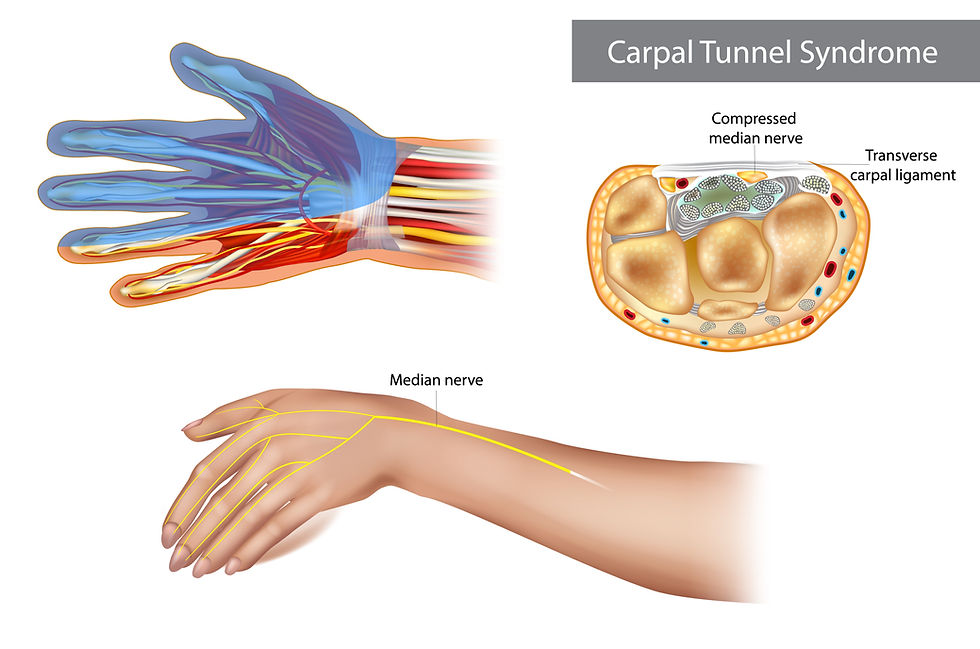
Carpal Tunnel Syndrome is a common overuse syndrome worth special mention here. Often, with repetitive movements of the hand or wrist, the tissues become irritated and inflamed, causing pressure on the median nerve in the wrist. This, in turn, causes pain, numbness, tingling, and sometimes swelling of the fingers (the thumb and middle three fingers) and weakness. This is common for people who use their hands a lot – hairdressers or stylists, assembly line workers, especially meat and poultry workers using handheld equipment, and those using vibrating tools. Sometimes, even working on a keyboard for many hours can cause carpal tunnel.
Some underlying factors can make it more likely: It is more common in females (caused by estrogen fluctuations); in some cases, it may be due to genetics (inherited predisposition), thyroid issues, arthritis, pregnancy, kidney, and diabetes.
Specific Approaches to Carpal Tunnel Syndrome
This should be treated early on and often responds to a wrist splint (especially at night when people tend to keep their wrists flexed, causing more pressure and damage to the medial nerve)
Anti-inflammatories (see below)
Rest the wrist and fingers (at least give your hand and fingers frequent breaks)
Surgery
Try not to flex your wrist too much while working. This puts pressure on the median nerve.
Managing Musculoskeletal Injuries: Taking care of Pain from Sprains, Strains, and Carpal Tunnel
These General Approaches Can Help You Manage Musculoskeletal Injuries Yourself:
Ice packs (initially) for 15 minutes three times a day and then, after three days, warm, moist heat applications for 15 minutes three times a day.
RICE
R - Rest
I - Ice
C - Compression
E - Elevation

Over-the-Counter Medications
NSAIDS: These include Ibuprofen (Motrin, Advil), Naproxen (Aleve), and Aspirin, and are quite effective in decreasing pain in many cases. They are always good medications to start with if you are having pain, especially pain from inflammation (almost all pain has some element of inflammation). BUT on a long-term basis, these medicines can cause gastric ulcers and bleeding as well as kidney and blood pressure issues, so beware - alternate your pain medications (NSAIDS) if possible - ibuprofen to Tylenol or a prescription medicine. Speak to your PCP about this, and also, consider taking a stomach acid-reducing medicine (common: omeprazole/Prilosec or famotidine/Pepcid and others) while taking NSAIDs. Remember: Aspirin thins your blood and can make you bleed more easily.
Acetaminophen (common: Tylenol), on the other hand, is not an anti-inflammatory but a pain reliever instead. This is also a good medication but used long term, can cause liver problems. Again, consider alternating this with ibuprofen every few weeks or speak to your PCP about getting another prescription pain medication.
Topical (applied painful area)
Diclofenac/Voltaren Gel (topically applied to the painful area)
Methyl salicylate - i.e., Icy Hot
Considered Alternative/Complementary Medicines for Pain
Oral:
Topical:
Prescriptive Treatments
High Dose ibuprofen (800 mg)
Joint injections (steroids)
Corticosteroids (prednisone, dexamethasone) have lots of potential side effects, from ulcers to diabetes, to hypertension to insomnia and sometimes downright psychosis, but they are great anti-inflammatories. Sometimes healthcare providers prescribe a low dose to use over the long term, but because of the potential side effects, it is good to look at some of the alternatives.
High dose ibuprofen (800 mg)
COX-2 inhibitors (common: celecoxib/Celebrex, meloxicam/Mobic) are anti-inflammatories. These are less likely to cause stomach problems than ibuprofen and other NSAIDs.
Opioids (short course) painkillers - These are painkillers such as oxycodone or hydrocodone (combo opioids with Tylenol: Lortab, Percocet, and Vicodin) and Tramadol (i.e., Ultram). Because these are highly addictive, they are not the drug of choice for long-term pain. They should not be used by recovering opioid addicts.
Steroid injections at the site of a joint problem can reduce swelling and inflammation
If you have any questions about your pain, see a healthcare provider. Treat early.


