
Basic Care of Cuts and Scrapes
Updated: Jul 1, 2025
Do I need Stitches?
The following is a discussion about the basic care of cuts and scrapes.
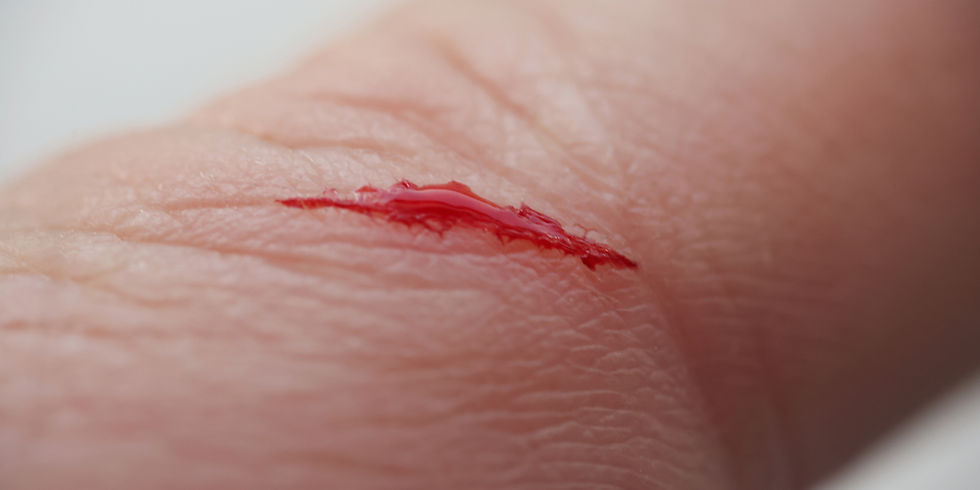
IF YOU CUT YOURSELF...Basic Care of Cuts and Scrapes
Initial Care:
Start with soap and water. Gently wash the wound with cool water (it helps stop bleeding faster than warm water) and a mild soap like Dial or Dove. Avoid harsh antiseptic soaps—they can irritate the skin more than they help (1).
Clean thoroughly. Remove any debris and wash the area for at least 20 seconds. Repeat this 2–3 times daily, or any time it gets dirty.
Skip the harsh stuff. Hydrogen peroxide and isopropyl alcohol may seem helpful, but they actually dry the skin and delay healing.
Apply pressure and elevate. For bleeding wounds, keep pressure on the area and elevate it—if it’s on a hand, foot, arm, or leg.
Daily Care: Keep the cut or scrape clean and covered with a clean, dry bandage. Dressings retain a slight amount of moisture, which supports healing. Most sources recommend that you
DO NOT leave it open to the air because it needs moisture to heal. If the bandage does get wet or dirty, replace it as soon as possible.
Should you put antibiotic ointment on it? Healthcare providers and dermatologists have recently recommended using Vaseline instead of antibiotic ointments like Neosporin and Bacitracin.
Cons of antibiotic ointment: Apparently, antibiotic ointments can cause skin sensitivities that delay healing. (You and I say, "But we have been using antibiotic ointment for years"! ),
Pros of Vaseline use: According to the American Academy of Dermatology, Vaseline keeps the wound moist, prevents a scab from forming (scabs delay healing), and helps prevent scarring.
Cons of Vaseline: Some researchers contend that even Vaseline may inhibit the development of the body's natural film to protect the injury from bacteria (yes, the body is a 'well-oiled machine'). And if you choose to use Vaseline, be careful—Old containers of Vaseline can become contaminated and grow bacteria!
So, knowing these things, what would be your best choice? Just keep the wound clean and covered and closely monitor it. If it is sticking to your dressing, use a non-stick dressing. If, despite your efforts, you think it is getting worse—increasing redness, warmth, tenderness, inflammation, or purulent drainage (pus)—you may want to discuss it with a healthcare provider to see if you need an antibiotic.
If you have not had a tetanus shot in ten years, it is recommended that you get one.
Bleeding: Some areas of the body bleed more than others. When you first get a cut, the initial fear is that it may be a hemorrhage! "Oh my gosh! I cut myself!". Apply pressure (preferably with a sterile dressing, but in dire straits, use what is available). If the blood is pulsing out of a wound, if you have numbness or tingling, if it is a gaping wound, or if an immense amount of blood continues to saturate dressings, apply more pressure, and, if you have not already, raise the extremity (if it is a finger, toes, arms or legs), and go to an urgent care, emergency department to have it evaluated. Word of warning: The scalp will tend to bleed a lot, no matter what type of wound. Of course, if the wound is very deep, get help!
Skin Q&A
Should I get stitches? Usually, if the wound is gaping (>0.25 inches deep), you will need stitches or medical-grade skin glue. A good rule of thumb is that if the wound continues to bleed despite your efforts to make it stop, it often needs stitches (if it stops bleeding initially and starts to bleed when you are washing, it then stops again with pressure; this is usually normal). If your wound needs stitches, depending on the area and the extent of the wound, it is good to attend to it as soon as you can. The type of wound, the degree of dirt, and the time frame of the accident will determine the need for suturing (According to Kaiser Permanente, a dirty wound or crush injury is typically done within the 6-hour time frame). A clean cut with a knife can usually wait 12-24 hours - usually no longer. But the sooner you take care of it, the better. The longer you wait, the more prone you will be to infection. An animal bite typically will not be stitched up.
Can I use superglue? This has reportedly been done successfully for minor, clean, and clean-cut (not jagged) lacerations because of the greater potential for scarring and infection. Pharmacies sell something like this for skin, over-the-counter for minor wounds (i.e., Dermabond) - ask your friendly pharmacist.
What about skin closure strips (Steri-Strips)? Skin closure strips can be found on the shelf in most pharmacies. They are suitable for clean, shallow wounds with straight edges that you can pull together. Like other wounds, if you use these, be sure the laceration is very clean and debris-free, and do it soon after the injury occurs.
Can I Use Duct Tape to Close My Wound? If that's all you have to close the wound, it may help temporarily to keep the edges of the wound together. But, it's really not recommended because it is not sterile and can introduce bacteria into a clean wound. You do not want to use it on anything dirty or potentially dirty: a puncture wound, a dirty wound, or an animal bite. That only keeps dirt and pathogens IN the wound, allowing things to fester up. Additionally, getting this tape off your skin is tough and might just open your wound back up!
