
Pet Allergies
Updated: Jul 10, 2025
It's a tough one...You love your kitty, BUT...I hear this all the time. You decide to suffer through it.
People have pets for all kinds of reasons: companionship, security, emotional support—or sometimes just for joy and amusement. During a lonely moment, a pet can even help you strike up a conversation with a stranger along the street! But, for those with pet allergies, a pet may not be much fun. Animal or pet allergies are quite common. Many times, they are just low-key sniffles, and people decide just to live with them.
It is the animal's dander that causes the allergic reaction. These are tiny flecks of dead skin that the animal sheds, and other minute particles from the environment found in the animal's fur/hair.
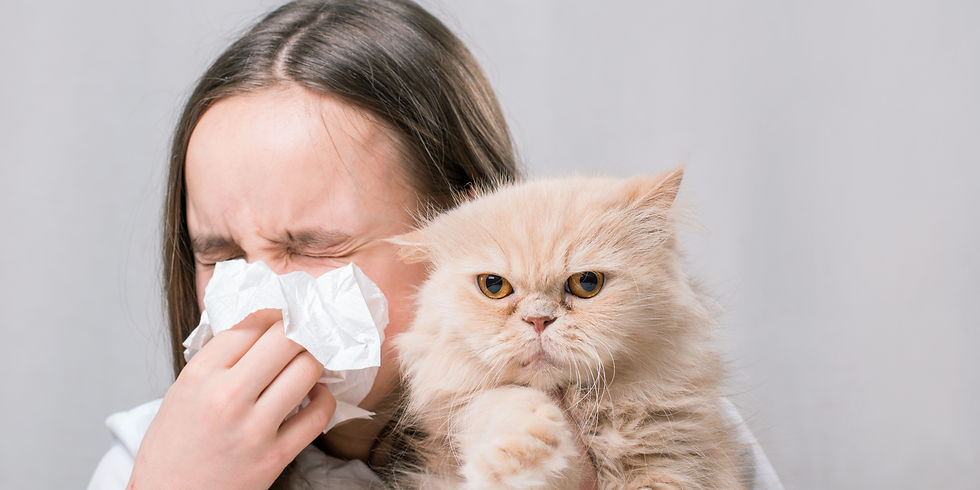
Some pet allergies may be mild, like congestion and itchy watery eyes, but others, particularly cat allergies. But occasionally, these can come on suddenly and be quite severe to the point of asthma-type symptoms or anaphylaxis. Feline saliva, itself, actually carries several allergens. After cats and dogs, the most common pet allergens reside in rodents (including hamsters, guinea pigs, and others), cute little bunnies, birds, cows, and horses.
People with "low-key" allergies to their pets or animals live with chronic congestion and/or a runny nose and often don't realize it. While others just live with their pet because they love their pet sooo much. And some people choose not to get pets at all.
If you think you may have pet allergies, it may help to look back at your history - ask yourself if the symptoms came on around the same time you got the pet.
Symptoms of Animal and Pet Allergies
Sneezing.
Runny or stuffy nose.
Facial pain (from nasal congestion)
Allergic salute (a crease near the tip of the nose from chronic wiping)
Pallor (pale) or blue hue under the eyes or in the nose.
Watery, red, or itchy eyes.
Hives, skin rash
Coughing, chest tightness, shortness of breath, and wheezing (This is a problem!)
If you choose to keep your pet, there are several common-sense things you can do to keep your allergies less severe:
Wash your hands after handling your pet
Stay hydrated (dehydration can cause an increase in histamines)
Keep your pet off the bed (ideally, out of your bedroom)
Be sure you keep your pet bathed and have someone brush your pet regularly.
Keep pet areas very clean
Change clothing after spending excessive time in close contact with your pet
Use an air purifier around the clock
Use a HEPA filter on your vacuum
Avoid using carpets
Use a Neti-Pot (exactly as directed)
Use special filters on your air conditioning and heating vents

Over-the-Counter Treatment for Pet Allergies
These may help. For less severe allergies, you can try the following over-the-counter antihistamines as directed, such as:
Oral antihistamines: diphenhydramine (Benadryl), (cetirizine (Zyrtec), fexofenadine (Allegra), or loratadine) Claritin.
Nasal antihistamines - Astelin and Astepro are also over-the-counter nasal sprays, which work differently because they are nasal antihistamines. Often, if the nasal steroids (above) are not working well, it may be good to try one of these, especially if the nasal steroids are losing efficacy. If this occurs, you may want to change from one to the other. These tend to work more quickly than nasal steroids.
Alternative/Herbal Approaches
Quercetin - This herb may be a good approach to relieving allergies: It has antihistaminic properties
Stinging Nettle - This herb is a frequently suggested herbal remedy for allergy symptoms due to its antihistaminic properties (1).
Butterbur - For symptom relief, it can sometimes help reduce allergy symptoms.
Prescriptive Approaches to Allergies
If your allergy symptoms become severe or cannot be controlled with over-the-counter medications or supplements, consider seeing your healthcare provider or an allergist for prescriptions. Your healthcare provider can prescribe allergy medications, and an allergist can investigate further and possibly perform some testing.
Flonase (fluticasone) (also over-the-counter)
Patanase (olopatadine) - Nasal antihistamine
Montelukast/Singulair - Leukotriene inhibitor (leukotrienes are responsible for many allergic /inflammatory diseases Note: Singulair is pretty effective for many people, BUT is getting a bad rap these days because some users are reporting depression as a side effect. A recent study reported that 32 per 1000 people taking Singulair reported depression.
Or...consider getting a pet that sheds less dander. For example, Bishon Frises, Yorkshire Terriers, many poodle types, Shih Tzus, schnauzers, and others. Cleveland Clinic has a nice list of these from The American Kennel Association (2),

