Eyelid Inflammation: A Stye
Updated: Aug 24

Styes (hordeola) are fairly common eyelid infections. They cause localized inflammation - swelling, tenderness, and redness of the eyelid within the lid (internal) or on the edge of it (external). These are caused by bacteria (usually Staphylococcus or "staph") that enter one of the hair follicles or glands of the eye, causing infection either in the inner or outer, upper or lower lid. While discomfort is usually confined to the lid, the eyeball may sometimes become irritated; there is typically no drainage or visual change unless severe. Besides pain, patients may complain that styes are unsightly.
A similar presentation resembling a stye is called a chalazion, a blocked oil gland. The latter tends to be chronic (comes back over and over), and while initially painful, the pain goes away. These can become large.
Eyelid Inflammation: A Stye
Management
Initial treatment for both a stye and a chalazion is conservative. See a provider if symptoms worsen, such as increasing pain, swelling, and redness. Occasionally, a pustular lesion may be present.
First: Apply a warm, moist pack for 15 minutes four to five times daily.
Second: Wash outer lids gently with antibacterial soap or (ideally) no-tear baby shampoo and warm water twice daily.
Last: Gently massage the area for 1-2 minutes, one to two times daily
Do not squeeze or puncture it! This often causes it to spread.
Over-the-Counter Approaches to "Styes"
Several over-the-counter eye ointments lubricate the eye and may relieve symptoms, but typically do not eradicate the infection.
Ointments and Drops:
Stye Ointment (Stye is the brand name) - May help - has had some positive reviews.
Similasan Stye Eye Drops - may help.
Do NOT use over-the-counter antibiotic ointments meant for other skin infections.
Natural Remedies for a Stye
Chamomile: Apply a warm, moist chamomile tea bag to your eyelid for 10-15 minutes, two to three times a day
Rosemary: Steep rosemary in water and place the solution on a clean cloth. Apply a warm, moist cloth to the outer lid for 10-15 minutes, two to three times daily.
Drops:
brazzoMD Stye Relief (calendula, arnica, colloidal silver/antibacterial, and vitamin B3) (apply to reddened outer lid) - Not for internal eye use. (Not an advertisement)
Practitioner/Prescriptive Approach to a "Stye"
Are other approaches not getting you anywhere? A healthcare provider can prescribe an antibiotic ointment. These usually work well.
Bacitracin ophthalmic (eye) ointment
Erythromycin ophthalmic ointment
Neomycin, polymyxin, bacitracin ointment
Tobramycin ointment or Tobradex ointment (Tobramycin with a steroid, dexamethasone)
If there is a lot of redness and swelling or if it does not improve after 3-4 days of treatment, you may need an oral antibiotic.
If the lesion becomes large or distorts your vision, an ophthalmologist may perform a steroid injection or an I+D (surgically opening the lesion and releasing pus).
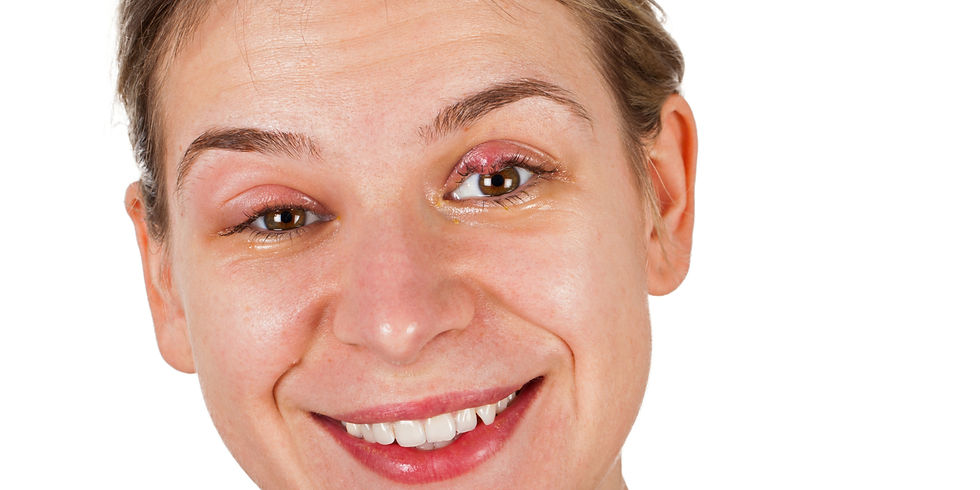
Why is she smiling? This eyelid inflammation—a stye—is nothing to smile about!
Reminders:
Don't wear eye makeup if you have a stye. If you get them repeatedly, think about what you are using near your eye(s) (makeup, moisturizers, and others) and change it up.
Don't wear contacts when you have this problem, and be sure to change out the pair you were wearing.