Depression Overview
Updated: Mar 28
Why Am I Depressed?
This overview is meant to help you understand what depression is, what can contribute to it, and the many different ways it can be managed.

According to the WHO (the World Health Organization), about 280 million people worldwide experience some depression. With so many possible triggers—environmental, social, familial, genetic, neurochemical, medical conditions, certain medications, and more—it’s no surprise that depression is so common. This overview is meant to help people understand their depression and explore the many approaches that can support better mental health. Try one. If it doesn’t help, try another. Keep going until you find what works for you. Treatment for depression is not a “one‑size‑fits‑all” process.
There are several kinds of “depression”. They fall on a broad spectrum, with sadness (a relatively short-term response to a sad event) at one end, and major depression (a long-term, sometimes disabling form of depression) on the other end. Where depression stands on this spectrum is based on symptoms and severity.
The American Psychiatric Association’s Diagnostic Statistical Manual of Mental Disorders, Fifth Edition (DSM-5) is, among mental health specialists, the “Bible” of psychiatric disorders. Among other things, to ensure consistency in diagnosing and understanding, they categorize types of depression and identify the respective symptoms.
The DSM-5 does not recognize normal “sadness” as a depressive disorder because it is considered a natural and relatively short-lived response. It is, however, discussed on this site because it affects nearly everyone at some point in their lives.
According to the NIH, the DSM-5 recognizes six types of depression:
Disruptive mood dysregulation disorder (usually associated with children)
Major depressive disorder (includes seasonal affective disorder, otherwise known as “SAD”;
Persistent depressive disorder (dysthymia)
Premenstrual dysphoric disorder - PMDD (this is a more severe form of PMS)
Substance/Medication‑Induced Depressive Disorder (depression caused by substances or medications).
All of these conditions share several basic symptoms — that’s what makes them part of the depressive‑disorders category. But if you explore the individual sections (above), you’ll see the specific features that distinguish each type.
Why Do People Get Depressed? Changes In Your Brain
It is important to understand that a person does not make a conscious effort to be sad or depressed; these states are not choices. Sadness and depression involve physical and emotional responses that can arise from stressful events, health conditions, or other physiological changes. When difficult experiences continue or when someone’s perception of an event becomes overwhelming, the brain can begin to process information differently.
As sadness becomes chronic or when depression develops, shifts in brain chemistry and neurotransmission can occur. The specific changes—and the brain regions involved—vary from person to person, depending on the type of depression and how long it has been present. Overall, research shows that multiple brain structures and physiological functions can be affected. Four important areas include the following:
The brain is made up of two main types of tissue: gray matter, which forms the outer layers, and white matter underneath. Gray matter contains neurons (nerve cells) that act like interconnected “wires,” carrying electrical and chemical messages throughout the body. It plays a major role in emotional processing, memory, thinking, information processing, and motor activity.
In some forms of depression—especially long‑standing or more severe depression—research shows that certain areas of gray matter, and occasionally white matter, can decrease in volume. When this happens, communication between neurons may not function as efficiently as it normally would.
Although most neurons in the brain cannot be replaced once they are lost, the brain can change the way the remaining neurons connect and communicate. This ability, called neuroplasticity, allows people to adapt, learn, and modify their responses to experiences over time. In many cases, these changes support healing and recovery. (Yes, there is hope.)
Changes in how neurotransmitters are released, how much is available, or how effectively they act on their receptors can contribute to depression. Neurotransmitters are the chemical messengers that help nerve cells communicate—essentially determining whether one neuron passes its signal to the next.
This is especially true for several key neurotransmitters involved in mood and emotional regulation. Serotonin, often associated with well‑being, is frequently less active in depression. Dopamine, which plays a major role in motivation and reward, can also be reduced. Norepinephrine, important for energy and alertness, is often lower as well. GABA, a calming neurotransmitter, may be less active, making it harder for the brain to regulate stress. Endorphins—the brain’s natural pain‑ and stress‑relief chemicals—can also be diminished in some people.
Together, these shifts can alter how brain circuits function, influencing mood, energy, motivation, and emotional resilience.
Cytokines can also influence changes in the brain’s functioning, the chemical messengers released during inflammation. When inflammation occurs in the body or the brain, these cytokines can alter how neurons communicate, affect neurotransmitter activity, and, in some cases, contribute to neuronal stress or damage. This inflammatory response can disrupt normal brain signaling and has been linked to changes in mood, energy, and motivation in many people with depression.
And last, but certainly not least, various hormones—such as estrogen and testosterone—can directly influence how neurons function, which in turn affects mood and emotional regulation. Progesterone also plays an important role and often has a protective effect on neurons. Hormonal shifts or imbalances can therefore contribute to changes in mood, energy, and overall emotional well‑being.
Much like anxiety, the feelings, perceptions, and behaviors associated with depression arise from underlying neurologic patterns that operate outside of conscious control. A person does not generally choose to be depressed — and that is actually good news. Because depression is linked to patterns of neurotransmission, those patterns can often be changed over time through intentional work: activities, therapies, and sometimes medications. This ability of the brain to reorganize itself is called neuroplasticity. And it means there is real hope for shifting depressive responses into something healthier and more positive.
Triggers of Depression: Causes and Treatment
Triggers
Don't know what's bothering you? Not sure what to do? Many different factors can contribute to depression. Sometimes it’s the environment—the things you see, the people around you—and sometimes it stems from physical or biological changes. When you understand what may be influencing your depression, you can explore different approaches to management and treatment, opening the door to a happier, more fulfilling life. If you’re not sure what’s affecting you, you may find some clarity here. You may find some insight on the following pages.
Approaches to the Management of Depression
Regardless of whether you know your specific triggers, the techniques below can support your well‑being. (Also see the section on major depression).
General Approaches to Depression
Reduce stress - Very often, there is a strong association between stress and depression.
Exercise, walking - Studies show that exercise can help relieve depression.
Meditation and relaxation exercises:
-Deep breathing exercises - This helps release endorphins in your brain, which are "feel-good" hormones. It also helps reduce cortisol levels, which, when high, can decrease coping. Deep breathing techniques are practiced by taking a deep breath through your mouth using your diaphragm muscle located just beneath your lower ribs (instead of using neck, shoulder, and upper chest muscles), pausing, and then releasing the breath through the mouth. Repeat this several times.
-Guided Imagery - Think of a relaxing situation or a place you have been and focus on only that - focusing on texture, smells, and visuals.
-Use Mindfulness - This is when a person focuses on the present moment, feeling and experiencing the moment with awareness and acceptance, not judgment. This reportedly helps the fronto-limbic area of the brain, which is responsible, in great part, for emotional regulation and processing.
-Progressive Muscle Relaxation Exercises: This is done by tightening muscle groups for eight seconds, then relaxing them for several seconds: Begin with facial muscles, with the face, moving to the scalp - tighten muscles for eight seconds, then relax; then the neck, doing with each muscle group of the chest, back, pelvis, extremities, and so on. This releases some tension and stress. If you do not have time to move through all of your muscle groups, do this with those muscles you believe have the most tension.
-Analytical Meditation - This meditation involves focusing on an object or a concept and focusing on only that.
-Body Scanning - Focus on a part of your body and feel relaxation, warmth, and release of tension.
-Reiki is a practice whereby a person connects with a universal positive energy. There are quite a few online sources with free instructions; additionally, many instructors also teach these methods in person.
Journaling: Write your thoughts in a journal
Talk to someone about your problem - friends, family: Don't worry, people who care about you are commonly concerned and want to help.
Practice affirmations - saying good things about yourself
Set realistic goals and work toward them: Start with small, achievable goals.
Listen to good music.
According to studies, aromatherapy (especially with massage) can be an adjunct in the treatment of depression.
Recognize and celebrate even small successes.
Humor therapy - laugh or make yourself smile (usually used as an adjunct to other therapies).
Light therapy - May help seasonal and non-seasonal depression in conjunction with serotonin reuptake inhibitors (SSRIs) and serotonin-norepinephrine reuptake inhibitors (SNRIs).
For some people, spirituality can contribute to a deeper sense of control, purpose, hope, optimism, peace, and connection; potentially improving overall health and well-being.
Massage - Studies show that massage has been shown to help with anxiety and depression.
Counseling and Therapy - These often help: Sometimes just being able to talk to someone can help more than you know. The best therapies all have one common bond: establishing a trusting relationship. If a counselor is good, they can work with you on different ways to cope and provide therapy that will suit your needs. Some of the more popular of these are mentioned below.
Cognitive Behavioral Therapy (CBT) - This is currently considered one of the best — if not the best — forms of therapy. There are several subtypes of CBT, but they all share the same core goal: helping people recognize and challenge the dysfunctional thought patterns that contribute to depression.
CBT is one way people can intentionally promote neuroplasticity, the brain’s ability to change and adapt. Through this kind of therapy, neurons can be encouraged to send impulses down new, healthier pathways instead of relying on old, negative ones. The brain forms new neural connections (or strengthens existing positive ones) through purposeful learning, repetition, and practicing more constructive thought patterns and positive experiences. Essentially, it’s a form of “rewiring.”
This means you can train your brain to think differently and more positively — and that makes sense when you understand how adaptable the brain truly is.
Types of CBT
-Cognitive Restructuring - Cognitive restructuring helps a person change the way they think about a situation. Through this therapy, a person learns to identify and challenge their negative or irrational thought patterns and develop more constructive ways of thinking.
-Dialectic Behavioral Therapy (DBT) - Similar to CBT, but with DBT, a person works on validating or accepting uncomfortable thoughts, feelings, and behaviors instead of fighting them. It emphasizes acceptance and change.
-Mindfulness-Based Stress Reduction Therapy (MBSR) - MBSR helps people change their responses to depressing or intrusive thoughts by using mindfulness practices to reduce reactivity.
-Motivational Interviewing (MI) - MI helps people identify positive goals and the strengths or internal motivations that can help them work toward those goals.
-Acceptance and Commitment Therapy (ACT) - ACT helps people accept difficult feelings and develop tolerance for them while learning new coping mechanisms and committing to actions aligned with their values.
Note: CBT is also effective for those with other mental health problems like anxiety disorders, PTSD, OCD, insomnia, chronic pain, and others.
Non-CBT Therapy
Psychoanalysis - Psychoanalysis is an interpersonal therapy that explores a person’s past, looking for possible roots of depression and working through the associated thoughts and feelings. It aims to help a person develop alternative, more effective coping mechanisms.
Eye Movement Desensitization and Reprocessing (EMDR) - EMDR is a therapeutic technique used to treat traumatic memories and, in this context, depression related to trauma. The therapist guides the client to focus their eyes on an object as it moves back and forth. At the same time, the client processes negative traumatic memories and gradually shifts toward more adaptive, positive associations. This approach is effective for many people and involves changes in how the brain processes and stores traumatic information — essentially a form of “rewiring.”
Other Approaches to Depression
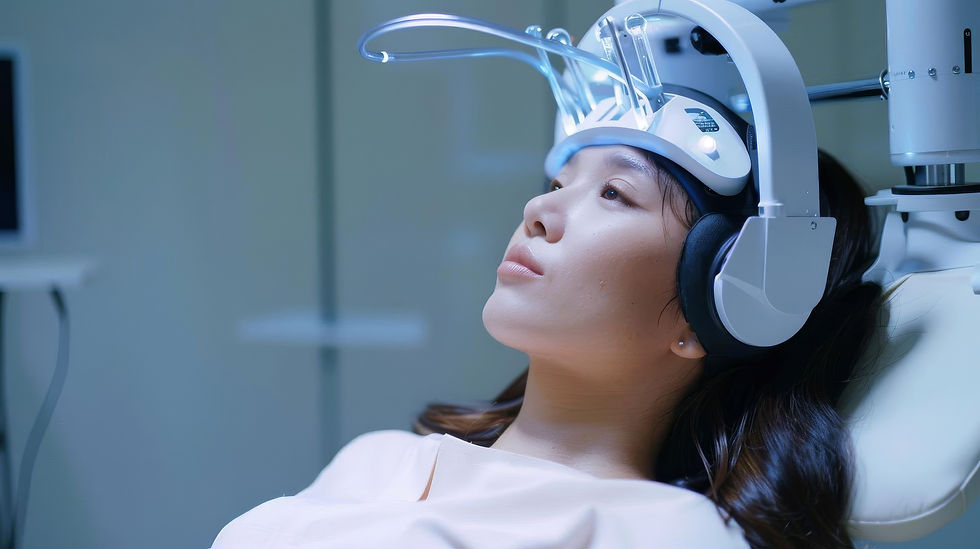
Transcranial Magnetic Stimulation (TMS) -
This treatment is sometimes used when other conventional treatments have not worked. A magnetic coil is placed on the scalp, and it delivers magnetic pulses, not electrical current, to stimulate specific areas of the brain involved in mood regulation. This stimulation can lead to changes in neural activity — essentially a form of “rewiring.” (See photo above.)
TMS is typically well tolerated, usually with little or no discomfort. It is often used as an adjunct to medication. Some consumer devices are available online, but they deliver much lower-intensity stimulation, are not FDA‑approved, and their safety and effectiveness cannot be assured. I’m not sure I would go this route.
TMS is a time‑consuming therapy. Treatments are, on average, about 30 minutes long, five times a week for approximately six weeks (this can vary). According to PubMed, about 36% of people experience improvement (other sources report higher numbers). Relapse can occur, but a person can undergo more than one course if needed.
This is often portrayed as an intrusive maniacal treatment straight out of One Flew Over the Cuckoo's Nest. But the fact is that it can work as a last resort when therapy and medication are not working. It is another type of electrical stimulation to the brain, more powerful than TMS, that elicits a small seizure under general anesthesia. The remission rate is higher than 50% and is best used in conjunction with and followed by antidepressant medications to avoid relapse, which can occur.
Over-the-Counter Medications
There are no reliable over‑the‑counter medications that treat major depression. You can try to support your health through lifestyle changes — getting enough sleep, reducing stress, eating a truly nutritious diet, and taking multivitamins (especially B12). While these habits may support overall well‑being and can improve mood to some degree, they cannot reliably treat moderate or severe depression.
Considered Natural and Herbal Remedies
It’s important to learn about herbs and supplements before trying them. Because most have not been extensively studied, their effectiveness for significant depression can be uncertain. Some may also interact with medications or cause unwanted side effects, so it’s wise to approach them with care and good information.
DHEA (dehydroepiandrosterone) is a substance produced by the adrenal gland. It is a prohormone or precursor to certain hormones, including estrogen and progesterone (among others). It also has neuroprotective effects and increases serotonin and dopamine levels in the brain. It has some medication interactions and quite a few potentially unwanted side effects; however, it may help with depression. As a mood enhancer in depression, DHEA usually takes up to six months for optimal effects. Because it does increase estrogen, there is a potential risk for those who have hormone-receptive cancer.
Omega-3 - Fish oil/krill oil - has a lot of beneficial properties for the brain (and possibly for depression): Decreases inflammation of the brain tissue, thereby protecting neurons from damaging effects. It reportedly has neuroplasticity benefits, and because it enhances communication between neurons, it promotes neuroplasticity. In general, Omega-3 protects the gray matter and white matter of the brain from some degeneration.
Omega-3s can take up to six months to work, so you may want to use them to supplement a prescription antidepressant medication.
Turmeric/Curcumin
Prescriptive Medications for the Treatment of Depression
In general, medication works better when used in conjunction with counseling. However, if a person truly does not want to engage in counseling, taking medication alone is usually still better than doing nothing at all.
Some people worry that they won’t be able to “feel” their emotions while taking an antidepressant. This effect, sometimes called emotional blunting, is one reason people stop their medications. If you notice this happening, it’s important to talk with the person prescribing your medication. There are many different antidepressants available, and finding the right one can be like finding a shoe that fits — sometimes you have to try several before you find the best match. In some cases, none of them fit well, and you may want or need to explore some of the other approaches discussed here.
SSRIs (selective serotonin reuptake inhibitors) and SNRIs (serotonin and norepinephrine reuptake inhibitors) are widely used antidepressants. These medications increase the availability of neurotransmitters involved in mood regulation — primarily serotonin and norepinephrine, and indirectly dopamine in some cases.
Common medications in this group include escitalopram (Lexapro), citalopram (Celexa), fluoxetine (Prozac), paroxetine (Paxil, Pexeva), sertraline (Zoloft), and vilazodone (Viibryd).
Tricyclic antidepressants also increase the availability of serotonin and norepinephrine. The best‑known of these is amitriptyline (Elavil). Because TCAs tend to have more side effects, they are prescribed less often than SSRIs and SNRIs. They are sometimes used off‑label to help reduce neuropathic pain.
MAO inhibitors are the oldest class of antidepressants, developed in the 1950s. They have many interactions with foods, drinks, medications, and herbs, so they are not used as frequently today.
Lithium is occasionally used off‑label (not FDA approved for a certain use) for treatment‑resistant depression when other treatments have not been effective. People taking lithium need close monitoring for side effects, and blood levels must be checked regularly.
Some newer potential treatments are in the early stages of testing and development. While early research shows promising results for depression, these approaches remain controversial because they involve substances that are currently classified as illicit drugs. These include:
Ketamine was originally used as an anesthetic during the Vietnam War and has been used for that purpose ever since. It is now a relatively new off‑label approach to treatment‑resistant depression. The benefit of ketamine is that, if it is going to work for depression (in roughly half of patients), it tends to work quickly—often within a few hours—and the effects can last for several days. For a person with severe, acute depression and suicidality, this may offer short‑term relief. The downside is that it can cause psychiatric or dissociative effects (such as feeling disconnected or experiencing perceptual changes or hallucinations). It has some potential for misuse, so it is generally not recommended for people with active substance use disorders.
Exactly how ketamine works in the brain is not yet fully understood. Several theories exist, but the primary premise is that ketamine blocks NMDA (N‑methyl‑D‑aspartate) receptors, which leads to changes in glutamate signaling and increased activity at AMPA receptors. This appears to enhance neuroplasticity and strengthen connections in brain regions such as the prefrontal cortex, which is involved in mood regulation. Because ketamine works on different brain receptors than SSRIs and SNRIs, it may be a useful option when a person does not respond to conventional antidepressants. Ketamine is also thought to promote greater neuroplasticity, helping the brain form new pathways that may support shifts in depressive thinking patterns.
Other theories are far beyond the scope of this site. For more detailed information, see the NIH‑linked review article Ketamine Treatment for Depression: A Review. There is a good deal of ongoing research and emerging information on ketamine.
Esketamine (Spravato) is an FDA‑approved relative of ketamine with similar antidepressant effects. It is a controlled substance used for treatment‑resistant depression and for depression with acute suicidal ideation or behavior. Treatment is administered under close monitoring in a clinic, and while some follow‑up steps may occur at home, the medication itself is not self‑administered outside a supervised setting.
Esketamine is given intranasally (Spravato). Ketamine itself may be given intravenously in off‑label settings, but esketamine — the FDA‑approved version — is not administered by IV. Treatment schedules vary, but esketamine is typically given twice weekly for the first few weeks, then gradually reduced as symptoms improve.
Psilocybin mushrooms are another emerging approach to treatment‑resistant depression. Like ketamine, psilocybin appears to enhance neurotransmitter activity and promote neuroplasticity. Research shows that psilocybin‑assisted therapy can produce rapid reductions in depressive symptoms, often within hours to days, and the antidepressant effects may last for several weeks or longer. More research is underway, and although psilocybin has shown significant promise for many people, it has not been approved by the FDA for the treatment of depression.
Because psilocybin can cause side effects such as anxiety, confusion, or paranoia, it is not appropriate for everyone. And because it can produce hallucinations and a psychedelic “high,” it is still classified as an illicit drug under federal law. When used for depression in research or clinical settings, psilocybin is always paired with counseling as part of a structured therapeutic process. It is administered under controlled conditions, and as of January 2026, the only state with licensed psilocybin service centers is Oregon. Colorado is in the planning phases.
MDMA - MDMA (3,4‑methylenedioxymethamphetamine) is another emerging approach being studied for mental‑health treatment. Although often associated with recreational use, clinical MDMA is a purified, precisely dosed medication used in combination with psychotherapy. It is not the same as street “ecstasy,” which is frequently contaminated or mixed with other substances.
In research settings, MDMA‑assisted therapy has shown promise for conditions such as PTSD, and early studies suggest it may also help people with severe or treatment‑resistant depression. MDMA increases the release of serotonin, dopamine, and norepinephrine, and it also reduces fear
Hopefully, the above symptoms and approaches to major depression will help you understand depression and the many strategies that can be used to help deal with it successfully. If one does not work, try another. If you believe you are depressed, you need to do something about it; otherwise, you just remain your old "dumpy" self. The answer rarely comes to you; you need to seek it out.
If you are suffering from depression, contact someone - a counselor, a friend, or a family member. If you are considering suicide, contact 9-1-1 You can talk, text, or chat. You can also access this site on your PC.